2026 Summer Research Lab Participants
Students: Patrick Baganski, Kerry O’Day and Alex Searle
OIRA Staff: Kevork Horissian, Rita Liu, Zirui Wang and Jocelyn Zhao
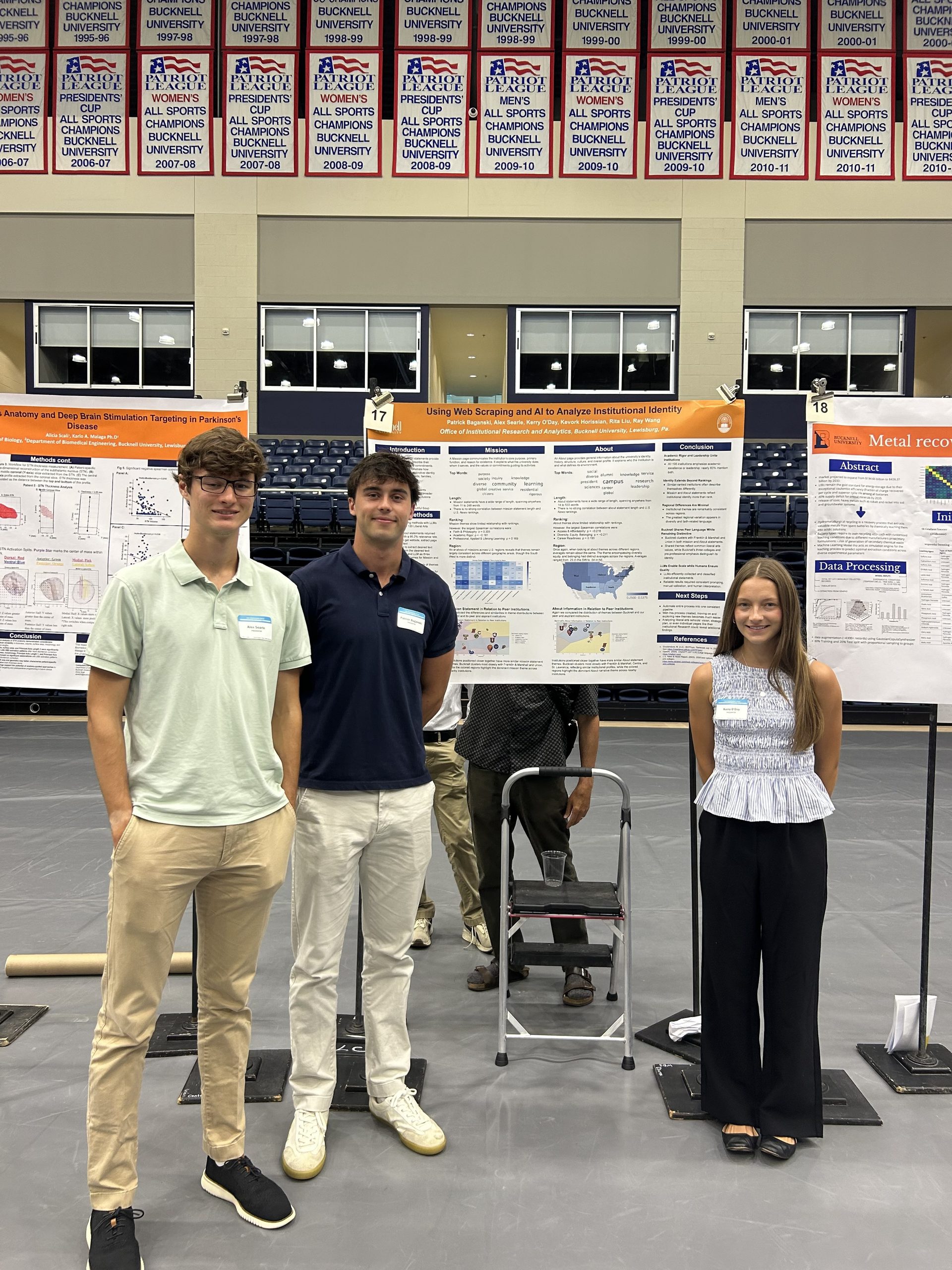
Every year, members of Bucknell’s Office of Institutional Research & Analytics (OIRA) work with Bucknell students on projects designed to address real questions facing the University. The Summer Research Lab gives students experience working with real business problems while applying research methods, data science, machine learning and AI. Students work with OIRA professionals throughout the entire process, from defining the problem and preparing the data to selecting analytical methods, evaluating results, and communicating findings.
Peer and Competitor Analysis Using AI
In summer 2026, students and OIRA staff developed a new approach to understanding Bucknell’s peers and competitors using web scraping, natural language processing and AI. The team built an agent to collect current information from publicly available institutional websites, then applied Latent Dirichlet Allocation (LDA), BERTopic, and large language models to identify and compare themes across institutions.
The project allowed students to tackle a real institutional challenge, producing timely insights on trends and responses in higher education. Students gained hands-on experience with the full data science process, including how to collect reliable data, transform large volumes of unstructured text, select appropriate analytical methods, compare results across models and translate findings into useful information for decision-makers. Their work provides Bucknell with a more timely way to identify emerging trends and understand how other institutions are responding to changes in higher education.
Strategic Analysis of U.S. News Best College Rankings
Students also worked with OIRA staff to examine factors associated with Bucknell’s U.S. News Best Colleges ranking and identify areas where institutional actions may have the greatest potential impact. Using statistical modeling, institutional and peer data, the team examined ranking stability, financial resources and student-success measures. The model projected Bucknell at No. 30, just one position from its published No. 29 ranking, and identified graduation rates, Pell recipient graduation rates, and first-year retention as areas where improved outcomes have greater potential to influence future performance.
AI and Qualitative Analysis
The Summer Research Lab also explored how AI and natural language processing approaches could analyze large volumes of text. Students compared analytical methods and interpreted themes, focusing on how to combine computational techniques with human judgment and expertise, emphasizing the importance of validation in applied data science.