November 12, 2026 from 12:00 – 12:50pm | Olin 268, Pizza provided!
Part of the Mathematics & Statistics Student Colloquium Series
Presented by Professor James B. Wilson, Colorado State University
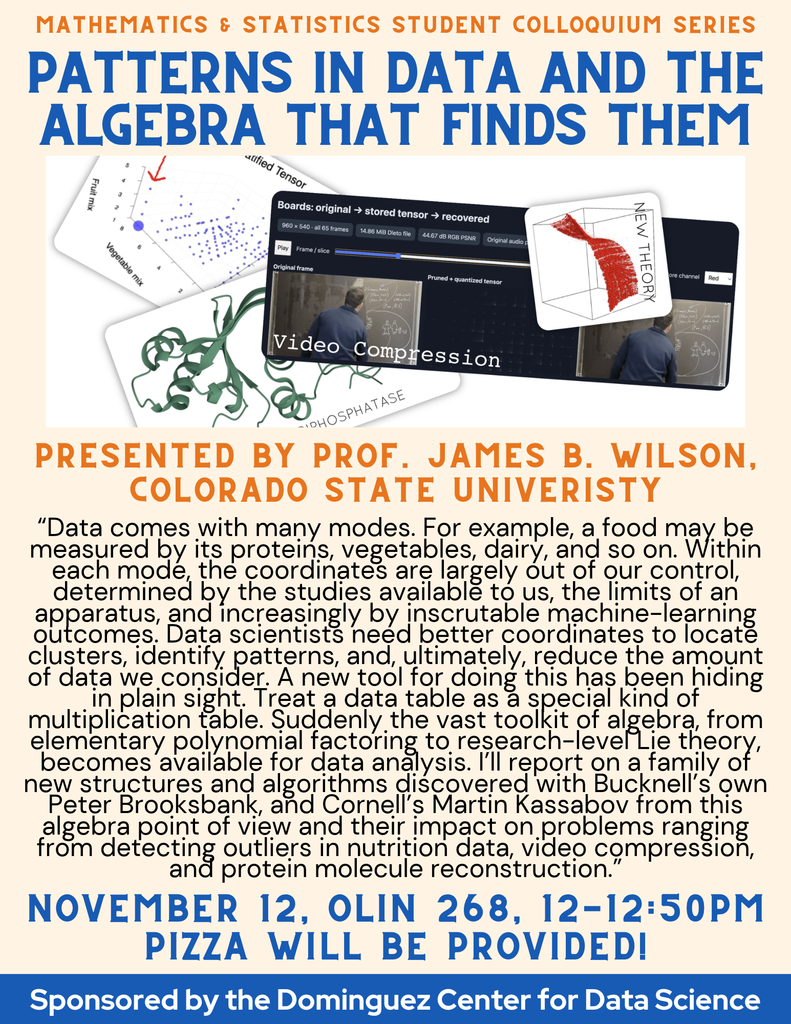
Data comes in many modes. For example, a food may be measured by its proteins, vegetables, dairy, and so on. Within each mode, the coordinates are largely out of our control, determined by the studies available to us, the limits of an apparatus, and increasingly by inscrutable machine-learning outcomes. Data scientists need better coordinates to locate clusters, identify patterns, and ultimately, reduce the amount of data we consider. A new tool for doing this has been hiding in plain sight. Treat a data table as a special kind of multiplication table. Suddenly, the vast toolkit of algebra, from elementary polynomial factoring to research-level Lie theory, becomes available for data analysis. I’ll report on a family of new structures and algorithms discovered with Bucknell’s own Peter Brooksbank and Cornell’s Martin Kassabov from this algebra point of view and their impact on problems ranging from detecting outliers in nutrition data, video compression, and protein molecule reconstruction.