The JoAnn Patrick-Ezzell ’75 & Andrew Ezzell Data Science Student Fellows Program
As part of the JoAnn Patrick-Ezzell ’75 & Andrew Ezzell Data Science Student Fellows Program (DSSFP), students work on semester-long collaborative data science projects through the Dominguez Center for Data Science. Each project has a stakeholder mentor who serves as the domain expert and a data science mentor who manages the project and provides analysis support. The student fellows also meet regularly with the Center Director to discuss best practices in data science and engage in efforts to support the Dominguez Center.
Apply to a Data Science Student Fellow for the Spring 2027 Semester!
The Dominguez Center for Data Science is currently hiring data science student fellows for the spring semester to work on collaborative data science & AI projects and to support the initiatives of the Center. This fellowship is part of the JoAnn Patrick-Ezzell ’75 & Andrew Ezzell Data Science Student Fellows Program and is an opportunity to grow your data science skills and toolkit, to participate in a mentored data project, and to have a positive impact on data science activities happening at Bucknell.
Students from all years and majors are encouraged to apply. If you are a student with an interest in data and experience with at least one data science software program (such as R, Python, or Excel), this is a great opportunity to grow your data science skills. We are looking for students who are eager to develop their data science skills by doing. Therefore, a willingness to dive in is more important than prior experience.
Find more details and application requirements in Workday below:
Fall 2026 Projects (in alphabetical order):

A Kingdom of Names: Data Mining the Holinshed Chronicles
Chris Garcia ’27 (Computer Science and Engineering), Minh Pham ’27 (Computer Science, Data Science), Gideon Daniels ’28 (Electrical Engineering, Management)
Mentored by Diane Jakacki (Comparative & Digital Humanities)
This project aims to produce a prosopography of the Holinshed Chronicles (1577). The Chronicles is a medieval document that focuses on British history and its legends. This requires analyzing a structured, machine-readable dataset of the people, places, and events described in the text, and then modeling connections among them to visualize networks over time.

A Novel Measure of Muscle Fatigue During Wall Sits
Kerry O’Day ’28 (Mathematical Economics) and Seth Preap ’29 (Computer Science)
Mentored by Ben Wheatley (Mechanical Engineering) and Rebecca Beneroff (Biology)
This project explores data collected from wall sit experiments to determine if knee wobble can be used as a measure of muscle fatigue. The main objective is to investigate the correlation between data generated from different sensors placed on the leg (sEMG and IMU). Ultimately, this will provide clinicians with an easy-to-use, reliable metric to evaluate hip and knee muscle function and assess injury recovery without the barriers of expensive or time-intensive traditional testing methods.
Admissions Marketing Attribution
Sophie Yang ’27 (Mathematical Economics) and Owen Paul ’27 (Economics)
Mentored by Jocelyn Zhao (Office of Institutional Research and Analytics) and Laura Winger-Bartell (Admissions)
This project partners with Bucknell University’s Office of Institutional Research and Analytics, along with the Office of Admissions, to uncover which communication methods for prospective students have the biggest impact on their decision to attend. The project team is analyzing mailing and demographic datasets to identify patterns across communication engagement, application stage, outreach type, and more. By understanding these patterns, the admission marketing attribution project aims to identify the most effective communication channels, help the office focus its resources, and ultimately increase prospective student engagement.

Analyzing the Volume of Bucknell’s Internet Consumption Over Time
Laura Ozoria ’28 (Computer Science and Engineering, Film and Media Studies) and Mackayla Teli ’29 (Computer Science and Engineering)
Mentored by Zirui (Ray) Wang (Office of Institutional Research and Analytics) and Aaron Gerrish (Information Technology)
Bucknell’s campus runs on a single fiber optic line, and the network team has been collecting usage data every minute since 2023. We want to know: what will usage look like a few years from now? Are there patterns we can project into the future? Using that data, we’ll build a forecasting model that captures patterns in the busiest times and how often internet usage spikes, giving us a picture of what to expect. The forecast helps Bucknell plan for network upgrades and negotiate a fair contract with its provider.
Assessing Presidential Fellows Outcomes
Minh Le ’28 (Chemical Engineering) and Kirandeep Dhillon ’28 (Mathematical Economics)
Mentored by Peter Brooksbank (Mathematics & Statistics), Jocelyn Zhao (Office of Institutional Research and Analytics), Elizabeth Durden (Sociology & Anthropology)
The project’s goal is to evaluate the outcomes of students who participated in Bucknell’s Presidential Fellows Program and compare them with non-Presidential Fellows. The project will analyze factors such as graduation rates, honors theses, Phi Beta Kappa membership, job placement, average earnings, and other measures of student success. The results will help the stakeholder better understand the program’s long-term impact and provide a more quantitative way to assess how effectively the program supported student achievement.

Closing Insights: What Drives Sales in the HVAC Industry
Ryan Carson ’28 (Business Analytics, Data Science), Cynthia Pintado ’28 (Computer Science and Engineering), and Huaning Yuan ’29 (Applied Mathematics)
Mentored by Matt Bailey (Analytics & Operations Management) and Assaf Weinberg (SetSale)
SetSale builds AI-driven sales-quoting software for residential heating, ventilation, and air conditioning (HVAC) contractors. The goal of this project is to mine SetSale’s data of HVAC quotes across 226 contractors to determine which contractor-controlled variables have the greatest impact on closing a sale and determine best practices in the HVAC contractor industry.
Data Analysis of Engagement with Academic Success Resources in CHEM 205
Noah Thomas ’28 (Statistics, Data Science) and Tim Shan ’28 (Applied Mathematics, Computer Science)
Mentored by Kelly McConville (Dominguez Center for Data Science), Laura Lanwermeyer (Teaching & Learning Center), Tim Strein (Chemistry), and Brian Smith (Chemistry)
Since 2023, Bucknell’s Chemistry Department and the Teaching and Learning Center have been working together to support development of quantitative skills and examine student’s engagement in academic success resources in the introductory Principles of Chemistry Course, which 20% of Bucknell students take. In an effort to further support students, the Chemistry Department made structural changes to the course to facilitate more opportunities to engage. Overall, student success increased when they utilized these resources. This project aims to closely analyze the data to quantify the impact of these opportunities and create a pipeline for future analysis.

Dataset Curation for Statistics Courses
Sabrina Qi ’29 (Statistics) and Amelia Rury ’29 (Mathematical Economics)
Mentored by Sara Stoudt (Mathematics & Statistics) and Susan Lloyd (Mathematics & Statistics)
This project aims to streamline the process of finding engaging datasets that are fit for particular teaching purposes across our statistics curriculum. By creating a well-annotated set of potential datasets and the characteristics we look for in data, this project provides a variety of examples and contexts in our classes.

Donor Engagement Analysis for The Green Dragon Foundation
Zoey Zeng ’27 (Mathematical Economics) and Ravi Benson ’29 (Business Analytics)
Mentored by Jimmy Chen (Analytics & Operations Management)
The Green Dragon Foundation (GDF) has a large collection of donor information, but much of this data is really difficult to use and analyze because of missing, inconsistent, or outdated records. Our project will improve the quality and organization of GDF’s donor database and use these data to better understand donor engagement and retention. We will identify patterns in giving and communication, develop tools to support fundraising decisions, and create clear reports and visualizations for the organization’s leadership. This work will help GDF strengthen donor relationships and make more informed, data-driven decisions.

Las Vegas Motorcoach Resort Rental Market and Operations Analysis
Briar Bryant ’29 (Computer Science, Data Science), Cindy Qin ’28 (Computer Science and Engineering), Ivan Contreras Fuentes ’29 (Electrical Engineering)
Mentored by Claire Cahoon (Dominguez Center for Data Science) and Laurie Nelson (Las Vegas Motorcoach Resort)
This project’s stakeholder, Las Vegas Motorcoach Resort, sells and rents luxury motorcoach lots. This project aims to help the stakeholder increase bookings and emphasize the resort’s luxury experience. The team aims to do this by cleaning and analyzing a full year of rental records to identify peak seasons, create website improvements, and analyze visitor stay patterns. Through this, our team will deliver resort management with actionable solutions to improve pricing and marketing, while providing tips to improve their online presence, showcasing their premier perks to potential guests.
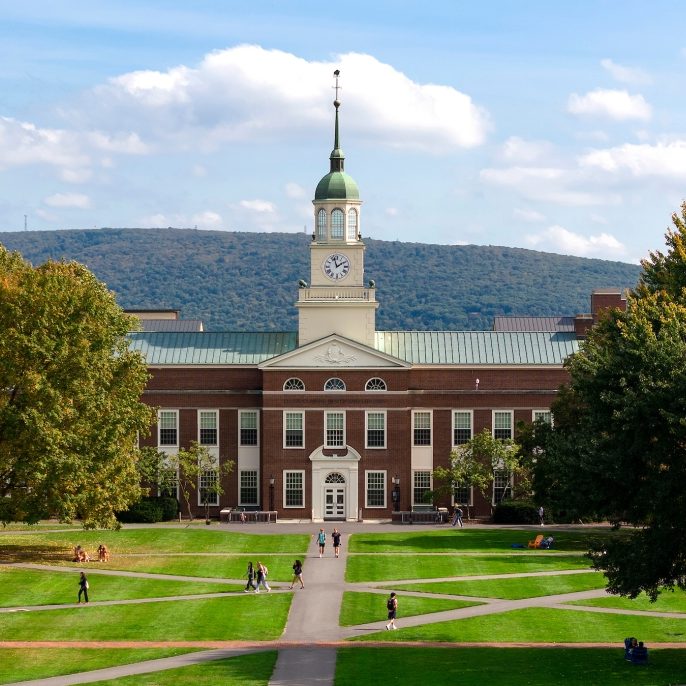
Late Night @ Bertrand: Rightsizing Library Service Hours
Minglang Du ’28 (Biomedical Engineering) and Sophia King ’28 (Computer Engineering)
Mentored by Claire Cahoon (Dominguez Center for Data Science) and Teal Cocomello-Hayes (Library Services)
This project analyzes data including foot traffic in and out of the main doors, study room booking logs, and checkout behaviors to evaluate late-night building usage at Bertrand Library. By pairing pre-existing custodial collected headcounts with our own observational data collection, our team aims to provide evidence-driven recommendations for rightsizing library hours, optimizing shifts, and efficiently utilizing campus spaces.
Photo by Emily Paine, Marketing & Communications

Listening to Student Voices: Analyzing Student Comments using Natural Language Processing (NLP)
Sushma Upadhayay ’27 (Computer Science), Maisie McGowan ’27 (Business Analytics), and Olivia Seward ’27 (Mathematical Economics)
Mentored by Rita Liu (Office of Institutional Research and Analytics) and Kevork Horissian (Office of Institutional Research and Analytics)
To enhance qualitative data analysis processes at Bucknell’s Office of Institutional Research and Analytics, this project develops a human-supervised AI workflow to analyze the National Survey of Student Engagement (NSSE) and the Getting to Know You survey. The ultimate goal is to synthesize findings from student feedback while determining the most effective use of artificial intelligence in Bucknell’s qualitative research, ensuring that human oversight is maintained to improve the quality of the analysis.

Morrow Farm and Lewisburg Community Garden Data Management to Improve Efficiency and Messaging
Akinkunmi Peter-koyi ’27 (Biology), Emma Gavin ’29 (Business Analytics, Data Science), Phuong Nghi Vu ’29 (Mathematical Economics)
Mentored by Rebecca Beneroff (Biology), Jen Schneidman Partica (Morrow Farm and Community Garden), Theresa Dollar (Morrow Farm and Community Garden), Mark Spiro (Biology)
This project analyzes data from Morrow Farm and Lewisburg Community Garden to understand their impact on students and the broader community. The team examines trends across harvests, donations, educational activities, and community engagement. Using quantitative data and qualitative narratives, the team will develop an interactive scrollytelling dashboard, allowing the story to unfold as users scroll through the data and highlighting the Farm and Garden’s impact.
Problem Solving of Practicing Engineers
Madison Molloy ’28 (Psychology, Mathematics), Sofi Jeffrey ’28 (Chemical Engineering, Mathematics), and Alnur Gazizuly ’29 (Computer Engineering)
Mentored by Jamaal Downey (Chemical Engineering) and Elif Miskioğlu (Chemical Engineering)
This project is part of a larger research area which seeks to discover the ways the problem-solving skill of intuition is used in engineering and how intuition can be better integrated into engineering education. Specifically, we apply qualitative analysis to a previously existing collection of interviews of practicing engineers to investigate the multifaceted ways in which engineers conceptualize their intuition, and why they may not think of it as such. Our team hopes to improve the way intuition is taught in engineering by modeling how practicing engineers understand their own intuition.

Reviving the Knuckleball: Why It Disappeared and What Could Bring It Back
Ava Sklar ’28 (Psychology ), Charlotte Driscoll ’28 (Mathematics), Minh Dau ’29 (Computer Science)
Mentored by Rajesh Kumar (Computer Science) and Bill Meek (Management & Organizations)
The knuckleball has nearly disappeared from Major League Baseball, but why? We will analyze MLB pitch data from 2008–2025, with detailed Statcast data from 2015 onward, together with weather and ballpark information. We will study how pitch movement, speed, spin, unpredictability, pitcher characteristics, and game conditions relate to knuckleball effectiveness. By comparing successful and unsuccessful knuckleballs across pitchers and seasons, we aim to identify the factors behind its decline and determine whether there are conditions in which the pitch could still be effective today.
Spending Equity in College Athletics: A Longitudinal Analysis of EADA Data
Patrick Baganski ’28 (Applied Mathematics), Rex Alphen ’27 (Finance), Taylor Modeski ’29 (Finance)
Mentored by Vaska Atta-Darkua (Accounting and Financial Management) and Joseph Wilck (Analytics & Operations)
This project examines how spending in college athletics is distributed and how it has changed over time. Using 22 years of financial reports that schools submit under the federal Equity in Athletics Disclosure Act, the project analyzes revenue, expenses, and coaching resources nationally and across conferences, with a focus on differences between men’s and women’s sports. The results will highlight where resource gaps persist, helping the public understand whether college sports are becoming more equitable.

The Impact of Gastrointestinal Conditions on Behavior and Treatment Outcomes in the Autism Inpatient Cohort
Coco Liang ’29 (Applied Math), Lilli Davis ’28 (Biology, Psychology), and Sara Corro ’28 (Economics)
Mentored by Kelly McConville (Dominguez Center for Data Science) and Alex Berry (Geisinger)
The goal of this project is to examine whether gastrointestinal conditions are associated with differences in behavior and treatment outcomes among autistic individuals in the Autism Inpatient Cohort. We will build models to compare behavioral measures between participants with and without GI conditions and explore whether specific GI disorders are linked to greater symptom severity, longer hospital stays, or differences in treatment response.
Could one of your projects benefit from data science support? The Dominguez Center for Data Science is currently looking for semester-long data science projects for fall 2026 and beyond. All faculty and staff are invited to submit a project proposal. Selected projects will be matched with a team of student fellows from the cohort we hire for the semester.
Each selected project will be allocated $2000 of research funds, with $1000 designated for the stakeholder mentors and $1000 for the data science mentors. The form also outlines the expectations of each team member. Submit your projects using the form below by October 31, 2026:
We have a broad view of what counts as data science and encourage you to think expansively in terms of how these collaborative projects could support your work. For inspiration, here’s an incomplete list of different types of projects:
- Analyzing and visualizing a dataset.
- Explore how a new technique or tool could advance your work.
- Transforming messy data into a more tractable form.
- Creating interactive dashboards.
- Mining texts for themes.
- Converting workflow to a reproducible format.
- Packaging up your code for easy dissemination.
Previous Semesters
Looking for a past project? See each past semester’s page for more information: