The JoAnn Patrick-Ezzell ’75 & Andrew Ezzell Data Science Student Fellows Program
As part of the JoAnn Patrick-Ezzell ’75 & Andrew Ezzell Data Science Student Fellows Program (DSSFP), students work on semester-long collaborative data science projects through the Dominguez Center for Data Science. Each project has a stakeholder mentor who serves as the domain expert and a data science mentor who manages the project and provides analysis support. The student fellows also meet regularly with the Center Director to discuss best practices in data science and engage in efforts to support the Dominguez Center.
Spring 2026 Projects

Automating extraction of zebrafish behavior from pre-recorded videos
Asher Fallows (Mathematics ’28), Akinkunmi Peter-koyi (Biology ’27), Meshkat Alam (Physics and Mathematics ’28)
Mentored by Nathan Smith (Biology), Peter Brooksbank (Mathematics), and Matthew Gay (Connective Consulting Partners)
Zebrafish have well-studied behavior, so this project’s stakeholder, Nate Smith from the Biology department, conducted an experiment in which he fed 3 groups of zebrafish 3 different diets to assess their behavior. His research students manually watched each video and marked behaviors, which took an incredible amount of time. This project is tasked to automate the data collection process to immensely speed up this process.

Coal Region Air Quality Data Visualization Dashboard
Samuel Tuffour (Computer Science and Engineering ’28)
Mentored by Brian King (Computer Science) and Dabrina Dutcher (Chemistry & Chemical Engineering)
This project focuses on improving access to local air quality information in Shamokin, Pennsylvania, a community impacted by a long history of coal mining. While air pollution is known to affect respiratory and cardiovascular health, there is limited high-resolution data available for this region. The project team is organizing, analyzing, and quality-checking data from a network of air quality sensors to better understand how pollution levels change over time and across locations. The goal is to build an accessible public dashboard that allows residents to explore air quality conditions and make more informed health and environmental decisions.

Current Parents: Understanding Survey Insights on Giving and Engagement
Malli Challa (Cell Biology and Biochemistry ’26), Paige Long (Business Analytics and Data Science ’29)
Mentored by Kelly McConville (Dominguez Center for Data Science) and Vanessa Hales (University Advancement)
This project analyzes survey responses from current parents of Bucknell students to better understand their connection to Bucknell, perceptions of giving, and interest in engagement opportunities. The goal is to identify patterns in what motivates parents to give, how informed they feel about the impact of donations, and what types of communication and involvement they value most. This project uses data visualization and text analysis to identify and highlight key trends and meaningful relationships. Overall, this project aims to provide actionable knowledge that can help strengthen parent engagement and philanthropic efforts/participation.

Data Gathering and Study of University Division 1 Sport Performance on University Hiring and Placement Outcomes
Ryan Carson (Business Analytics and Data Science ’28), Alex Fraser (International Relations ’26), Sabrina Qi (Statistics ’29)
Mentored by Joe Wilck (Analytics & Operations Management) and Vaska Atta-Darkua (Accounting & Financial Management)
This project investigates whether strong NCAA Division I athletic performance is linked to improvements in broader university outcomes, such as rankings, financial growth, and student career placement. Building on the concept known as the “Flutie Effect,” we aim to examine whether athletic success generates measurable institutional benefits over time. The team is gathering and integrating more than ten years of publicly available data from sports, government, and university sources. They will build statistical models to explore these relationships, and create visualizations to share results with the Bucknell community.

Deal Engine
Sophie Yang (Mathematical Economics ’27), Casey King (Computer Science and Engineering ’26), Dipesh Bhattarai (Mathematical Economics ’27), Wais Almakaleh (Computer Science & Engineering and Physics ’28)
Mentored by Claire Cahoon (Dominguez Center for Data Science), Kelly McConville (Dominguez Center for Data Science), and Chris Breaux (Emberline)
This project’s client, Emberline, is a private equity firm that invests in small and mid-sized businesses. They receive large lists of potential companies to review, many of which are not a good fit, and currently, this screening must be done manually. The project aims to automate the first stage of this process by classifying each company’s business/revenue model, customer type, and end market. The tool will allow Emberline’s team to quickly filter out irrelevant companies and focus their time on the most promising opportunities.
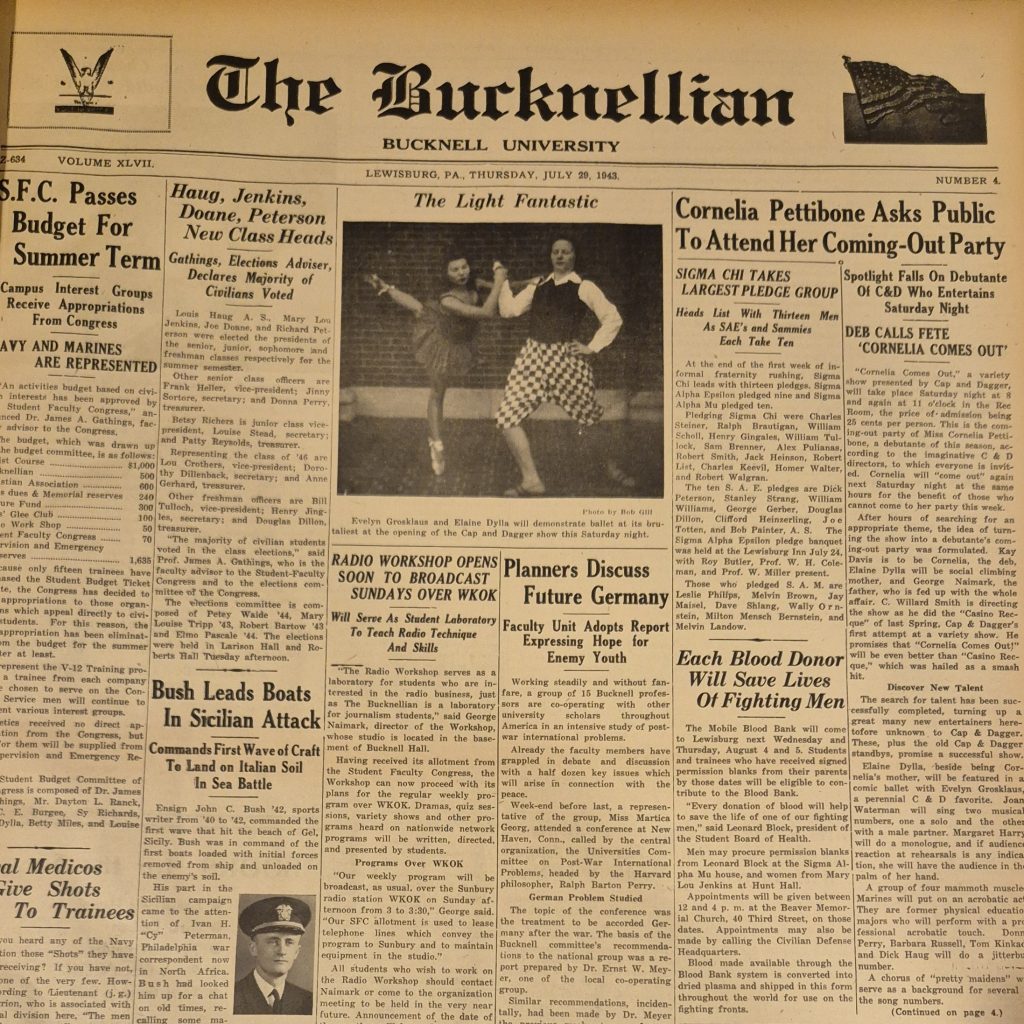
Digital Text Analysis of The Bucknellian Student Newspaper
An Ngo (Computer Science and Mathematics ’26), Sanda Tan (Linguistics, Psychology, and Math ’28)
Mentored by Claire Cahoon (Dominguez Center for Data Science), Todd Suomela (Digital Pedagogy & Scholarship), and Susan Falciani Maldonado (University Archivist & Director, Special Collections)
This project focuses on digitizing the Bucknellian Student Newspaper from the past (since 1920). The goal is to come up with a way for researchers or the curious peruser to efficiently search for information and analyze the text.
Evaluating the Clinical and Economic Outcomes of an Emergency Department Medication Bedside Delivery Program
Marissa Walck (Accounting ’27), Patrick Baganski (Applied Mathematics ’28)
Mentored by Alia Stanciu (Analytics & Operations Management), Vaska Atta-Darkua (Accounting & Financial Management), and Joe Wilck (Analytics & Operations Management)
The Meds to Beds (M2B) program at Geisinger allows Emergency Department (ED) patients to receive prescriptions before leaving the hospital, addressing barriers like transportation limitations and improving medication compliance. This project aims to build a dataset for the analysis and do preliminary analysis on the Emergency Department’s Meds to Beds program’s effectiveness.
Experiences of First-Generation Students at Bucknell
Emma Button (Applied Mathematics ’29), Briar Bryant (Computer Science & Data Science ’29)
Mentored by Diane Jakacki (Comparative & Digital Humanities) and Chris Brown (Center for Access & Success)
This project analyzes trends in responses to interview questions to identify strengths and weaknesses within GenFirst student programming. Using eight interview transcripts from the Center for Access & Success, the project analyzes students’ personal anecdotes about navigating through academics and campus life. The project team is using a codebook to identify key themes across the interviews to inform the center of what’s going well or poorly with existing programs and help with future support programs for first-generation students. They are using distant and close reading methods to undertake this work.

Finding Opportunities for ShiftMed through Data Explorations
Noah Thomas (Statistics and Data Science ’28), Sushma Upadhayay (Computer Science ’27), Kerry O’Day (Mathematical Economics ’28)
Mentored by Kelly McConville (Dominguez Center for Data Science) and Todd Walrath (ShiftMed), Lizette Cruz (ShiftMed), and Jake Marcoulier (ShiftMed)
ShiftMed is an app that nurses use to find shifts where they live. Using data on users of the app this project is exploring how to improve user retention on the app. This project plans to find distinct user groups, such as “power users”, to improve user’s long term engagement with the app and to inform recruitment of new users.
From Archive to Avatar: Assessing the Feasibility of Parameterized AI Lecturer Model Generation
Ryan DePalma (Economics ’26), Laura Ozoria (Computer Science & Engineering and Film and Media Studies ’27), Zoey Zeng (Mathematical Economics ’28)
Mentored by Diane Jakacki (Comparative & Digital Humanities), Michael Fountain (WriteBrain Films), Brenton Gregory-Morley (WriteBrain Films), and Helen Carey (WriteBrain Films)
This project team is tasked to determine if the human and pedagogical elements of live-to-tape lectures can be successfully transferred to and retained within an experimental AI lecturer model. Specifically, can we train AI models to capture the humanity of teaching (including non-verbal cues, natural pauses, and “perfect imperfections”) to enhance engagement? The project will also address how to automate the process of scraping videos for verbal and non-verbal elements.
Mapping Small Business Assistance: Engagement and Impact Across Central PA
Caitlyn Hickey (Applied Mathematics ’26), Fayrene Nguyen (Business Analytics ’26), Tamim Rahman (Geosciences ’28)
Mentored by Janine Glathar (Digital Pedagogy & Scholarship), Claire Cahoon (Dominguez Center for Data Science), and Steven Stumbris (Small Business Development Center)
Bucknell SBDC provides consulting and educational support to small businesses in five PA counties and seeks to distribute its resources evenly across the region. This project will use spatial analysis to spot where the assistance is limited, what services are used more than others, and how outcomes differ across demographic and economic variables. Through the use of an interactive dashboard, SBDC’s staff will be able to identify areas of growth and expand the outreach of the center.

Modeling Music Royalties
Shaheryar Asghar (Economics and Mathematics ’28), Ryan Firestone (Political Science ’26), Kellen Remley (Computer Science and Math ’28)
Mentored by Matt Bailey (Analytics & Operations Management) and David Dunn (Shot Tower Capital)
This project is analyzing royalty data from the Mother Bertha music publishing catalog to better understand how songs generate income over time. The project team organised and cleaned semi-annual detailed royalty statements from 2018 to the present, examining trends across streaming, performance, mechanical, and synchronisation royalties. Using this data alongside music consumption metrics, they are studying how listening behaviour connects to earnings. The goal is to build a financial model that projects future royalties and helps assess the long-term value and stability of the catalog.

Predicting Gene Alterations Based on Food Supply for Yeasts
Jack Beneigh (Computer Science Engineering ’26), Joshua Kearstan (Chemical Engineering ’26)
Mentored by Jude Okolie (Chemical Engineering) and Hannah Yocum (Chemical Engineering)
This research is developing predictive models to optimize the selection of genetically modified yeast for sustainable bioplastic production. While bio-based plastics are eco-friendly, they are currently too brittle and expensive to replace traditional fossil-fuel plastics effectively. Supported by the Chemical Engineering Department, this project analyzes laboratory data to identify and predict the best genetic combinations, bypassing the slow and costly process of manual trial-and-error. By creating this “digital shortcut,” the aim is to accelerate the development of high-quality, affordable alternatives that can transform the plastics industry.

Predictors of Infants’ Attention to Musical Video Chat
Ibrahim Tahir (Computer Science & Economics ’26), Ava Sklar (Psychology ’28)
Mentored by Jimmy Chen (Analytics & Operations Management) and Haley Kragness (Psychology)
This project examines what grabs and loses babies’ attention during live versus Zoom music performances. The project team is using data from babies’ eye movements and matching the time intervals to the music performance to see whether changes in audio features affect babies’ looking behavior. To do this, they are using the MATLAB MIR toolbox and Python to extract and synthesize the data. Ultimately, the goal is to see what features are the most prominent in informing the looking behavior of infants to understand how they engage with music across different platforms.
Spreadsheet Resource Needs Assessment
Elizabeth Allardyce (Biology ’26), Minh Le (Chemical Engineering ’28), Coco Liang (Applied Mathematics ’29)
Mentored by Katie Akateh (Research Services) and Laura Lanwermeyer (Teaching and Learning Center)
The Teaching & Learning Center, along with faculty and staff, has recognized that students enter courses with widely varying levels of experience and background knowledge in spreadsheet tools. These differences may create gaps that affect students’ ability to succeed in courses that require tools such as Excel and Google Sheets. In response, this project involves creating and distributing a needs-based assessment to identify gaps in students’ spreadsheet knowledge and experience. THe project team is surveying both students and faculty, collecting and organizing the data, interpreting the results, and using these findings to inform actionable strategies for additional support.
Visualizing Sound Spectra of a Whistle
Jorge Gherson (Physics ’27)
Mentored by Brian King (Computer Science) and Indranil Brahma (Mechanical Engineering)
This project has a dataset containing the sound spectra of a whistle collected at different mass flow rates, pressures, and frequencies. The main objective is to visualize the sound spectra in a way that would allow a Convolution Neural Network (CNN) or a human to efficiently see the relationship between the sound spectra and the mass flow rate.
Previous Semesters
Looking for a past project? See each past semester’s page for more information: